Sustainability
More with less. Every decision is weighed against its impact — on energy, on material, on climate — so that beauty never comes at the planet's expense.
The escalating climate crisis urges us to design for more with less. We believe every project — and every person behind it, designer and client alike — holds the power to shape the earth for the better.
We design buildings that give back more than they take — spaces of lasting value, made to outlive trends and tread lightly on the world that holds them.
Sustainability and climate-responsive architecture means solving complex, interwoven problems — circular design, energy efficiency, climatology and holistic thinking — all at once.
To be truly impactful, we work alongside material manufacturers, engineers, scientists, biologists, cultural experts and policymakers, pooling knowledge and perspective to meet the complexity of our time.
As architects and urbanists shaping the earthscapes of the future, we know the work is shared.
More with less. Every decision is weighed against its impact — on energy, on material, on climate — so that beauty never comes at the planet's expense.
From date-palm waste to reclaimed materials, we design within the circular economy — regenerative, bio-circular systems where nothing is wasted and everything returns.
Architecture exists for people. We design spaces that lift the everyday — healthier, calmer, more human places to live, work and gather.
We create spaces that refuse passing trends — choosing craft, local workshops and sustainability in service of the people who inhabit them. Places of calm, made also to be shared.
We partner with developers and institutions to bring visionary architecture that performs — from efficient site utilisation to brand differentiation to accelerated project success.
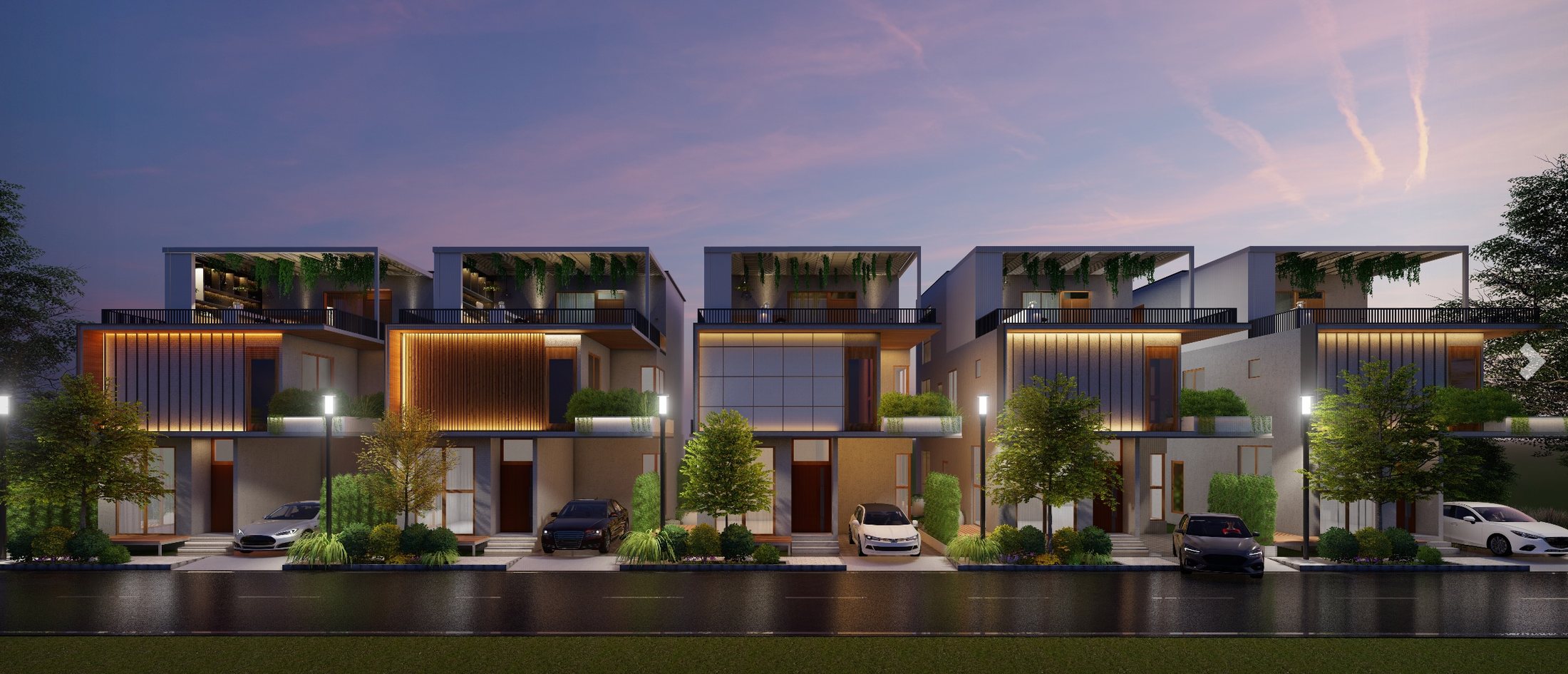
We reduce project risk and cost through integrated disciplines — architecture, engineering and sustainability working as one — with measurable impact. A strong example is the Bidadi Smart City project, where our agile design and delivery systems enabled key infrastructure within just six months, without any delays. Each villa can be completed within six months from the date of registration, supported by multiple plan types and customisation options for buyers.
Completed two premium mixed-use buildings.
Launched a smart-city development of 100+ villas.
Our Palm Pavilion was installed at the D3 during Dubai Design Week, showcasing date-palm waste as part of the circular economy.
Shortlisted among ten firms across the MENASA region for the ABWAB commission.
Our design for public rest spaces from recycled materials was showcased in the India Pavilion at the London Biennale.
Awarded second place in the L&T Innovation Hub Competition.
Selected to design a pavilion in the D3 district for Dubai Design Week 2020.
Shortlisted among nine firms globally for the UK's Letchworth Garden City Open Call.
New milestone…
Doing more does not mean taking more — each project gives back to the place that holds it. Start where it matters to you.
Whether you are shaping a home, a campus or a city block, our studio is here to help you build with intention. Tell us about your project — we'd love to begin.
Tash@tasharchitects.comBy submitting you agree to be contacted about your enquiry.
Museums, mixed-use, retail, workplace and urban masterplans — developer- and institution-scale projects delivered across three continents. Select any project to view the case study.
Looking for something specific — a sector, a site scale, a delivery timeline?
A focused 30-minute call to understand your site, programme and timeline — and how integrated design and delivery can reduce risk, cost and time-to-market. Share a few details and we'll propose times.
By submitting you agree to be contacted about your enquiry.
We'll review your project and reply with two or three proposed call times.
A memorial to the civilian victims of the Korean War — a reminder that the tragedy of war extends far beyond the battlefield.
This memorial honours the civilian victims of the Korean War, reminding visitors that the tragedy of war extends far beyond the battlefield.
The design separates the site into two distinct realms — a quiet, contemplative Memorial Park, and a vibrant, ecological Recreational Park — with the Konyreong Stream forming the natural boundary between them.
Set beside a widened stretch of the stream, the Memorial Building offers a powerful, immersive journey:
Beyond the indoor exhibits, meandering Memorial Paths are lined with name-story plaques linked by white string elements — a garland of unity and peace. Wooden decks overlook the excavation sites, preserving them as places of remembrance.
On the eastern side, the recreational zone invites both active and passive recreation:
Paths follow the natural topography, encouraging visitors to engage with the landscape, with shaded seating beneath randomly planted native trees.
Environmental stewardship shapes every aspect of the design:
The tragedy of war extends far beyond the battlefield.
MUTUC — a sculptural museum that turns Turin's centuries-old chocolate heritage into an experience, from cocoa's ancient myth to modern indulgence.
Turin is a city of rich history and disciplined character, defined by landmarks such as the Piazza Castello and the Mole Antonelliana. Within this context, a disused site near the renowned Shroud Museum is poised for renewal — transformed into MUTUC, the Turin Chocolate Museum: an architectural and cultural destination celebrating one of the city's most beloved traditions.
Envisioned as more than an exhibition space, the museum's craft workshops, cafés and community gathering areas create a vibrant hub for residents and visitors alike — linking Turin's progressive spirit with its centuries-old chocolate heritage.
Our concept, Amaze, is designed to captivate from the very first glimpse. Playful, sculptural forms build anticipation before visitors even step inside, turning the building itself into a storyteller.
Bold architecture turns museums into cultural icons that draw global attention and strengthen the local economy — exactly the impact we envision for MUTUC.
Chocolate has fascinated people for centuries; here, the museum becomes a living narrative, inviting guests to follow the journey of cocoa from myth to modern indulgence.
The visit ends on a sweet note — a coffee and chocolate shop placed just beyond the live production area, inviting guests to savour and take home Turin's world-famous confections.
An unforgettable finale to the museum's story, and a daily destination in its own right.
The journey of cocoa — from myth to modern indulgence.
A place of community worship and a quiet reminder of the Creator — an enduring rock of refuge and strength.
This chapel is conceived as a place of community worship and a quiet reminder of the Creator — an enduring rock of refuge and strength.
Its form draws from the dramatic hills that embrace the site: dynamic, yet steadfast.
The architecture mirrors the strength of mountains and the gentleness of faith.
The result is a humble, durable and uplifting place of worship — one that strengthens social ties while sitting lightly on the land. The chapel honours local materials and skills, inviting the community into the weaving, brickwork and assembly of their own sanctuary.
The strength of mountains, and the gentleness of faith.
A dynamic cultural landmark for Banja Luka — where the clarity of modernism meets the opulence of the past, and culture and technology coexist.
The Banja Luka Multicenter is envisioned as a dynamic landmark that captures the city's forward-looking spirit while celebrating its rich multicultural heritage. Drawing on the traditions of three nations, the design balances the clarity of modernism with the opulence of the past — a setting where culture and technology naturally coexist.
The architecture itself seems to move: sweeping forms sway, twist and dance, inviting visitors into a world of art and innovation.
The concert hall's façade is framed with vertical elements that recall the strings of a harp, while the theatre features dramatic billowing glass panels.
Approaching the complex, guests pass through landscaped courts planted with Banja Luka's native wildflowers and shrubs — an experience that engages every sense before entering the soaring, light-filled lobbies.
Inside, the concert hall and theatre interiors borrow from the city's cultural richness, rendered in vibrant contemporary materials that heighten the drama of music and performance.
In contrast, the exhibition halls embrace a crisp, minimalist modernism suited to science and technology displays — together offering excitement, wonder and discovery.
The master plan integrates concert hall, philharmonic workspace, theatre, exhibition halls and offices through seamless vertical and horizontal connections.
Visitors can move throughout the complex without stepping outdoors — a practical response to Banja Luka's cold winters. Shared service areas optimise scale and economy, and the buildings can be constructed in phases, with the concert hall and theatre blocks able to stand independently.
Sustainability is integral to the concept. Generous glazing captures natural light to reduce heating and energy costs, while geothermal systems support efficient climate control.
The front piazzetta is reserved for pedestrians and landscaped seating, with vehicular access confined to the rear and side — aligning with existing and planned parking.
A harmonious meeting ground for all cultures and generations — a new, inclusive Banja Luka.
A dynamic India in perpetual motion — a sculpture of twists, turns and shifting vistas, driven by rapid growth and constant transformation.
A dynamic India in perpetual motion — driven by rapid growth and constant transformation. The built form expresses this energy through a series of twists, turns and shifting vistas, revealing continuously changing views and perspectives as visitors move through the sculpture.
The design seeks to create an immersive experience of kinesis, where movement becomes central to perception.
A helical, DNA-like spiral spires towards the sky while remaining tied to the Chakra at its base — an India that aspires to new horizons yet stays rooted in her formative values.
As visitors ascend the winding staircases and arrive at multiple platforms, the relationship between form, space and landscape is in constant flux — each step offering a new visual encounter.
This dynamic journey extends beyond the visual. The sculpture is complemented by a sensory layer, where wind chimes sway in kinesis with natural forces.
The result reinforces the dialogue between architecture, motion and environment — for those experiencing the space from within and without.
Movement becomes central to perception.
A flood-resilient vacation home amid paddy fields — an iconic stilted form built for premium short-term rental appeal.
The client envisioned a vacation home in their hometown that could also function as a high-quality Airbnb rental. Located amidst expansive paddy fields, the site offers a serene and picturesque setting that strongly influenced the architectural response.
To address the area’s susceptibility to flooding, the house was designed as an A-frame structure elevated on stilts. The iconic form not only ensures resilience and safety but also establishes a distinct architectural identity.
The A-frame typology was intentionally chosen to impart a premium character — enhancing the property’s appeal and positioning it to attract discerning short-term rental guests.
A café design portfolio across Bangalore — warm, subtle interiors built for comfort, not spectacle.
We have designed multiple cafés across the city, many of which have become popular neighbourhood destinations. Each project followed brand-specific guidelines while creating warm, welcoming interiors that encourage visitors to relax — whether alone or with friends and family.
Unlike our museum projects, these cafés were intentionally subtle — prioritising a calm, soothing atmosphere over bold architectural statements.
From consistently positive Google reviews, we know that the design goals of comfort and immersive hospitality have been successfully achieved.
An organic, flexible pavilion that blends into the landscape — a place for children's workshops, performance and gathering, drawn from the undulating contours of the hills.
The client brief called for an organic, flexible space to host hobby-based workshops for children from nearby low-income schools. Beyond this community role, the space was envisioned as a performance venue for dance and adaptable for corporate events — allowing for multiple modes of occupation.
Set against the scenic backdrop of the Nandi Hills, the site offered expansive, spectacular views.
The design approach was guided by a sensitivity toward the surrounding landscape: the intent was for the structure to blend seamlessly with its context, avoiding intrusion through either form or material.
As a result, the built form draws its language from the undulating contours of the hills — a green roofscape that rises and falls with the terrain.
The spatial layout is conceived as open, fluid and multi-functional — accommodating a range of activities while creating generous vantage points that frame the surrounding scenery.
Materiality plays a key role in reinforcing the connection to nature. A carefully considered palette of bamboo, steel and coconut fibres (coir) balances sustainability, structure and craft.
The undulating roof took shape in the studio, worked out through hand-built physical models — each one testing how the surface could fold down to meet the ground, then lift to open generous views toward the hills.
The structure does not sit on the land — it moves with it.
A wetland visitor center that merges with the dunes — a green-roofed habitat for both birds and people at the Al Wathba Wetland Reserve.
South-east of Abu Dhabi, the Al Wathba Wetland Reserve — a 5 km² protected area since 1998 — hosts over 260 species of birds and wildlife including shrimp, scorpions and lizards. Each autumn through spring, as many as 4,000 pink flamingos migrate here to breed and spend the cooler winter months.
Dubai Design Week invited concepts for a new visitor center — an information hub, café, terrace, souvenir shop, specimen displays, training rooms and parking — that would demonstrate sustainability and constructability while preserving the reserve's delicate ecology.
Inspired by the rolling sand dunes, the proposal blends seamlessly with the landscape — ensuring the building merges with the natural habitat rather than intrudes upon it.
A green roof, planted with native drought-tolerant bushes and pockets of dry straw, expands the reserve's habitat by providing additional nesting areas for birds, while naturally reducing cooling loads and carbon emissions.
Merging with the dunes — sustainability, climate & environment
Immersive interiors — plan, shaded parking & bird-watching spaces
The center connects children and adults with the reserve — offering school programs, guided walks and immersive encounters with wildlife. Its architecture invites people to experience the wetlands up close while reinforcing the importance of environmental stewardship.
The building does not intrude on the habitat — it becomes one.
Façade concepts for a retail-and-office building — each guided by an elegant, timeless architectural language.
Façade concepts were developed for this retail-cum-office building, which also includes a rooftop helipad. Each design option was guided by an elegant, timeless architectural language — ensuring the structure remains visually relevant for decades without the need for stylistic updates.
A family of façade options explored proportion, depth and shading — each a variation on the same restrained, enduring vocabulary.
The revitalization of a long-abandoned commercial building — adaptive reuse on a constrained budget.
This project involved the revitalization of a long-abandoned building in a prominent commercial district. Closed and unused for several years, the structure presented both a challenge and an opportunity for adaptive reuse within a constrained budget.
By introducing a strategic palette of paint treatments, landscape interventions and minimal structural modifications, the building was reactivated with a renewed identity and presence.
This targeted approach transformed the complex into a desirable retail environment — ultimately attracting high-end retailers for long-term lease agreements.
Say it with flowers — a compact, modern kiosk that brings elegant floral experiences to every corner.
A modern, minimal and inviting flower kiosk, designed to create meaningful connections through elegant floral experiences. Compact yet impactful, it brings beauty to every corner — a bold, modern structure with a transparent, inviting display and a smart, efficient layout built for high visual appeal.
Re-imagining brick-and-mortar retail as a social experience — a network of shaded experience squares for Dammam's climate.
Re-imagining retail spaces — rethinking the future of brick-and-mortar. As e-commerce grows at a rapid pace, physical stores face shrinking profits and an identity crisis. Traditional formats — large, enclosed outlets with little room for interaction — are no longer enough. To remain relevant, retail spaces must offer time-resilient experiences that draw people even when they have no immediate need to shop.
Historically, market squares thrived because they were places to meet, converse and relax — not just to buy goods. The design embraces this tradition, making community engagement and human connection central to the retail experience.
A network of rich experience squares — pedestrian streets at ground level linked to vibrant terrace plazas above.
Treating socio-economic needs as the driver of design, the project reinvents how people socialize and do business in public arenas. By merging commerce with community, it ensures that offline retail remains vibrant and indispensable in the digital age.
A multi-level supermarket with a street-front café and corporate offices above — shaped by evidence-based retail research.
We were commissioned to design a multi-level supermarket featuring a welcoming street-front coffee shop, with corporate offices on the upper floors.
Extensive retail research and user-flow studies informed the concept. The design incorporates evidence-based guidelines — from circulation patterns to merchandising zones — ensuring a smooth shopping experience and efficient operations.
Façade studies for a flagship retail complex — arched masonry, sculpted stone and a luminous diagrid skin.
A family of façade concepts developed for a flagship retail complex — each exploring a distinct architectural language for the street frontage while sharing a common two-storey volume and a stepped entrance plaza. The first study pairs a brick base of generous arches with a veined-stone upper level; a second sets a single monumental arch against tall arched apertures; a third wraps the upper storey in a faceted diagrid glass skin, a crystalline counterpoint to the masonry below.
A mixed-use landmark stacking retail, offices and residences behind a playful, cantilevered façade.
This project began as our proposal to the client: a mixed-use building combining retail on the first two levels, offices in the middle floors, and residences on the top.
The architecture creates a playful, eye-catching façade of cantilevered box forms that draw visitors toward the retail spaces. On the lower floors, angled glazing increases visibility of merchandise for both pedestrians and passing traffic.
To manage the region’s intense sun, most glazing is oriented north, while west- and south-facing windows are shaded by projecting balconies. Upper office levels open to generous landscaped decks, offering breakout spaces and natural shading that reduce heat gain and significantly lower energy use.
The result is a community landmark — a dynamic building that blends shopping, work and living while setting a new standard for sustainable urban design.
A high-end retail frontage built on simplicity, flexibility and cost efficiency — premium presence without premium cladding.
The structure was designed for high-end retail, with a concept rooted in simplicity, flexibility and cost efficiency. Rather than relying on expensive cladding systems, the design prioritises easily renovatable paint-based finishes that offer high visual impact while keeping initial investment and future modification costs low.
Cladding materials were deliberately avoided in favour of a restrained palette of textured paints and slim-profile glazing systems, allowing the architecture to achieve a refined, premium aesthetic through proportion, detail and material articulation. This approach ensures the retail space remains adaptable over time — balancing luxury with practicality.
A corporate campus designed as a living ecosystem — to connect, collaborate and conserve, targeting LEED Gold / IGBC.
Competition brief — designing innovation hubs. Create a commercial campus that functions as both a workplace and a community hub, inspiring innovation and cultivating a healthy company culture. The programme spans offices, canteen and amenities, a customer experience centre, a product development centre (the innovation hub), service buildings, parking and security blocks.
The master plan embraces a modern, urban work environment guided by green-building principles. Targeting LEED Gold / IGBC certification, the design optimizes energy use, minimizes waste and reduces long-term maintenance — with international benchmarks for landscape and planning that foster community and interaction.
Large corporate campuses often struggle to balance human connection with resource stewardship. The concept addresses both through the 3 Cs:
Two development centres and their parking flank the site, converging at a central Amenities Hub of dining, recreation and meeting spaces — minimising walking distances and encouraging unplanned encounters. An outdoor waterway with semi-shaded seating and enclosed pavilions supports informal collaboration.
The proposed campus is a living ecosystem — a place where employees connect, collaborate and conserve, setting a benchmark for sustainable workplace design.
Office interiors built on two ideas — less is more, and green is more.
Office interiors for Press Ganey (now Forsta), an American software firm based in Technopark, Kerala. The design embraces two guiding principles — "Less is more" and "Green is more."
The result is a bright, uncluttered office that promotes focus and well-being while reflecting the company's modern, forward-thinking ethos.
A compact travel-agency office where brand expression and space efficiency lead.
A compact office designed for a well-known travel agency in Kerala, where space efficiency and brand expression were key.
A bright, brand-aligned colour palette enlivens the space and reflects the agency's spirit of agility and adventure — a welcoming workplace that communicates a dynamic identity while making the most of every square foot.
Playful, brand-aligned office environments for Technopark software firms — and a compact retail office in Nagercoil.
A selection of office environments designed for software companies in Technopark, Thiruvananthapuram. Though each client had unique requirements, the briefs consistently called for open layouts with generous breakout zones to encourage collaboration and creativity.
We responded with vibrant, brand-aligned colour palettes and playful details that help employees step away from the routine and stay energized through the day.
Across Cinch, Apolis and Revyrie, the same approach carries through — bold brand colours, playful breakout zones and graphic detailing that keep each Technopark workspace energised, while a cohesive, modern aesthetic ties the spaces together.
A stadium that becomes housing — an adaptive arena and residential community that keeps New York's waterfront park alive after the 2026 World Cup.
Archstorming international competition entry — New York City. Archstorming invited proposals for an adaptive stadium that can also function as a residential building — operating both uses simultaneously, alternating between them, or converting permanently to housing after the 2026 FIFA World Cup. The indicative programme: a soccer field, 45,000-seat stands, residential units (30–100 m²), restaurants, offices, shops, multi-purpose spaces, gardens and public areas.
Our concept envisions a year-round destination where sport and urban living coexist — keeping the park active long after tournament days.
The result is a sustainable, mixed-use landmark — a dynamic arena and residential community that keeps New York's waterfront park active, vibrant and economically viable long after the World Cup ends.
A nature-immersive boarding school where children stay connected to the outdoors — built from local Erode brick.
Commissioned by the school's principals, this campus was envisioned as a nature-immersive learning environment — where children remain connected to the outdoors, both visually and through direct sensory experience.
Every space is designed with strong visual links to the surrounding landscape, while individual classrooms open to private courtyards that support multi-sensory activities and hands-on learning.
Façades are crafted from Erode's locally produced brick, reducing transport impact and blending with the verdant setting. This warm, vernacular material gives a timeless character that painted surfaces could not achieve — keeping the campus rooted in its environment.
The result is a school where students spend their days constantly aware of nature and its value, fostering respect for the environment as an integral part of their education.
A windowless basement crèche made bright, open and cheerful — a place toddlers love while parents work.
Designed for a major IT park, this crèche provides a safe, stimulating environment where employees can check in on their toddlers during breaks.
Located in a fully enclosed basement with no natural light, the space was intentionally crafted to feel bright, open and cheerful. Colourful finishes, reflective surfaces and playful lighting create an uplifting atmosphere that offsets the absence of windows.
The layout encourages learning through play and sensory exploration — with touch-and-feel features and interactive elements to keep children engaged throughout their waking hours.
Special care was given to the nap rooms, designed to feel warm and inviting so toddlers settle in comfortably — easing the often-challenging transition to rest time.
A small, accessible reading room for rural Tamil Nadu — a circular pavilion of curved rammed-earth walls and interlocking S-block masonry, gathered around a tree-shaded courtyard.
The Reading Circle brings an inclusive, accessible reading room to rural villages in Tamil Nadu — a low-cost learning and gathering space planned from the ground up around the needs of residents with disabilities, including wheelchair users and those using crutches, canes or walking frames. Its circular plan turns the building into a community circle, drawing villagers in around a central, tree-shaded courtyard.
The result is a welcoming, climate-responsive pavilion that fosters both learning and a genuine sense of community — designed to be transferable to villages well beyond its original site.
A 100% community-built pavilion for Tottenham's artisans — a grassroots model for temporary public space.
An architecture-led placemaking project proposing a new model for temporary public space — inspired by the distinctive culture and self-organized ethos of the Harringay Warehouse District.
Developed as an open competition entry, the proposal envisioned a pavilion to host the works of local artisans, temporarily transforming a disused Tottenham car park into a one-off, inclusive space for the wider community. Amid rapid gentrification, this part of London has become increasingly unaffordable for many of the area's long-established artisans.
Conceived as a community-led initiative, the pavilion was designed to be entirely self-built by local residents — fostering collective ownership, mutual support and shared capacity-building. Through creating, programming and managing the space together, the project sought to strengthen economic resilience and offer a grassroots response to displacement.
With 100% community construction and curation, the project positions itself as an alternative to the top-down urban change prevalent across London. It draws directly on the co-creation principles of the Harringay Warehouse District — a rare, self-shaped enclave of artists, makers and performers — replicating its collaborative spirit as both method and message.
A self-sustaining cyclists' shelter clad in solar fabric — for Dubai Design Week's Urban Commissions.
Created for the Urban Commissions open call during Dubai Design Week (D3) 2019, the brief invited large-scale public installations that engage the community through participatory, multisensory design. Our concept focused on encouraging cycling to work in Dubai.
Cycling shortens long office commutes, improves productivity, keeps the air clean and reduces fuel use. Our design supports Dubai's bike-friendly ambitions with an inviting rest-and-recharge shelter for cyclists.
Clad in photovoltaic solar fabric, the shelter generates clean energy to power on-site amenities — air pumps, water dispensers and bike-charging stations. Beyond comfort and utility, it acts as a visual statement, celebrating a citywide shift toward sustainable, active transportation.
The Color Blob Bench — a vivid, climbable community perch from reused materials, quarter-finalist at the LFA Pews & Perches 2020.
The London Festival of Architecture's 2020 Pews & Perches competition invited benches that celebrate material reuse and draw on the Royal Docks, its waterfront and community. Our entry reached the quarter-finals.
The Color Blob Bench injects vivid colour into the grey dockside — like a splash of paint on pavement. The sculptural form seats two, with an elevated mound for children (or adventurous adults) to climb and slide, plus a small integrated planter.
Benches arrange in a wide "V" to encourage conversation while keeping distance. The Color Blob Bench turns leftover materials into a vibrant community perch — encouraging interaction, play and sustainability on the Royal Docks.
A Mashrabiya reimagined in date-palm fibre and recycled plastic — heritage geometry meeting bio-circular innovation, for Abwab 2024.
For the 2024 edition of Abwab — Vernacular Futures, designers were invited to explore vernacular architecture's role in regenerative design. Vernacular traditions — local materials, climate-responsive techniques and community-centric thinking — were the starting point.
We reinterpreted the Mashrabiya as a pavilion for ambient outdoor gatherings that shields visitors from the Middle East's intense climate. The structure combines naturally cool date-palm fibres with recycled plastic — abundant regional waste products, yet durable enough for long-term use.
While the form is contemporary, it draws on familiar traditional geometries — showing how ancient ideas can meet modern technology. The concept is threefold:
Three pop-up pavilions for D3, Dubai Design District — a sculptural, flat-pack streetscape of folded copper and golden-triangle geometry.
The Dubai Design Festival is a celebration of ideas, art, music, food and architecture that draws thousands of visitors to D3 each year — a rare platform where design, art, fashion and cuisine converge into a single immersive experience.
To reflect that energy, we developed three distinct pop-up pavilion concepts:
The modular unit is based on golden-triangle geometry, producing two differently sized interior spaces plus integrated storage. By varying the arrangement of these triangular modules, the design builds a dynamic streetscape — with pockets for outdoor seating, cafés and landscaping — while keeping a clear pedestrian flow along the central path.
The V-shaped larger modules host restaurants, outdoor cafés or pop-up venues for talks and presentations. Each pavilion carries dedicated signage space and tucks storage into its triangular corners; the bases are wider than the upper sections, giving the structures inherent wind resistance.
All models are built from lightweight aluminium composite panels — durable, cost-effective and available in a wide range of UAE-sourced colours — paired with scratch-resistant Plexiglas glazing, the same material used for aircraft windows.
A streetscape that folds flat and unfolds anywhere — geometry doing the work of ornament.
Low-rise luxury apartments built for space and daylight, not density.
Commissioned as a boutique residential development, this project focuses on spacious layouts and abundant natural light rather than high density.
Each home features generous private balconies and floor-to-ceiling windows — inviting fresh breezes and daylight while offering expansive views. The result is a low-rise block that combines the privacy of a standalone residence with the conveniences of modern urban living.
A city-centre family home on a trapezoidal plot — a courtyard oasis, an inverted roof in motion, and cedar-warm interiors.
In the vibrant heart of the city, this family home occupies a distinctive 3,000 sft trapezoidal plot with an unusually long road frontage. The design embraces the geometry — using the extended frontage for an open, flowing plan that blurs the boundary between inside and out, organised to capture daylight and cross-ventilation.
At the rear, a secluded courtyard is carved out as a private oasis. Landscaped with native plantings, it becomes the family's informal gathering place — for leisurely meals, children's hobbies or quiet evening conversation — drawing daylight deep into the home and offering a calm contrast to the city.
The roofline introduces a striking gesture — a series of playful, inverted, inclined planes that lend movement and drama to the long, narrow volume. These dynamic forms break up the massing and create changing silhouettes through the day, while discreetly handling rainwater drainage and natural cooling.
Inside, extensive use of cedar wood infuses the rooms with a soft red hue and natural fragrance — a tactile warmth that complements clean modern lines. Generous glazing frames views of the courtyard and street trees. The result is a city-centre retreat that balances privacy with connection, and compact urban living with moments of serenity.
A residence for entertaining — a sleek, textural palette and a drought-tolerant landscape that honours its environment.
For this Bangalore residence, the brief called for sophistication and flexibility — generous seating clusters, a bar counter for entertaining and a cohesive modern aesthetic.
The solution pairs a sleek material palette with rich textural contrasts in paving, structural elements and the rejuvenated façade. Winding paths framed by statement planters lend a sense of journey and grandeur.
Every plant selection reflects the client's wish — and our principle — that landscapes honour their environment, relying on hardy, drought-tolerant species that flourish with minimal upkeep.
A bright, breezy family home on a triangular plot — warm, modern, and a much-photographed local favourite.
Set on a 1,900 sft triangular plot, the TA Residence presented both challenges and opportunities. The long road frontage became a key design advantage — allowing a home that feels open, bright and connected to the outdoors.
Minimal internal walls create an easy flow between living areas, while several decks and terraces extend the living space into the garden for year-round outdoor enjoyment.
Today the TA Residence is a beloved family home and a visual favourite — often requested by Instagrammers as a backdrop for reels and shoots, proof of its welcoming charm and enduring appeal.
A home built around conversation and entertaining for the founders of Bangalore's first pub chain.
Our clients, Gilbert and Suja, are well-known Bangalore entrepreneurs who pioneered the city's first chain of pubs under the "Gilly's" brand. Their brief called for a home designed around conversation and entertaining — with intimate group settings that reflect their sociable lifestyle.
The layout features multiple interconnected seating areas and generous openings to the surrounding garden — a seamless indoor–outdoor flow that supports relaxed gatherings and lively discussion in a lush, natural setting.
A light-filled tropical bungalow for a family returning to Kerala — open volumes under monsoon-ready sloped roofs.
Designed for a family returning to Kerala after many years in the Middle East, this residence reflects their wish for a spacious, light-filled bungalow suited to the region's tropical climate.
The plan features generous double-height living areas, expansive decks and wide glazing that open the interior to surrounding greenery. In response to Kerala's heavy monsoon rains, gently sloped roofs reduce long-term maintenance and waterproofing costs — while giving the home a distinctive profile.
A modern retirement retreat built for hospitality — open, luxurious, and tuned to Cuddapah's climate.
Designed for a respected couple seeking a peaceful retirement home, this residence reflects their wish for a modern, spacious retreat that can also welcome a large circle of family and friends.
The plan emphasises open, interconnected living areas with multiple indoor and outdoor seating alcoves that encourage conversation and nurture strong social bonds. Interiors are luxurious and contemporary, aligning with the clients' clear preference for a style free of traditional references.
Generous verandahs, garden gazebos and drought-tolerant plantings suit Cuddapah's hot, humid climate. More than 90% of glazing and verandahs face north and east — shielding interiors from harsh southern and western sun while capturing breezes for cross-ventilation and abundant daylight.
A bold, kinetic Bangalore home where dipping rooflines and cantilevered volumes meet stark red-and-white surfaces — open, light-filled rooms carved from a single simple volume.
The house is sited with its longer axis running east–west, minimising harsh western exposure while drawing soft north light deep into the interior. Dipping lines and cantilevered volumes give the elevation a sense of motion, and a stark red-and-white palette amplifies that dynamism.
The plan is a simple twenty-foot-wide rectangle running the length of the site, allowing direct cross-ventilation and consistently well-lit rooms. Living, dining, kitchen, the master bedroom, decks and a library are carved from within this single volume using minimal internal walls — creating open, continuous spaces that make the most of the views the site offers.
A “more for less” community of 100+ villas — spatial generosity, daylight and comfort delivered within compact plots and a budget-conscious framework.
This 100-plus villa development was conceived around the planning principle of “More for Less” — an approach focused on delivering spatial quality, environmental comfort and functional completeness within compact plot dimensions and a budget-conscious framework.
The primary design challenge was to create homes on relatively small sites without compromising the perception of openness, daylight access or livability. In response, the villas were planned with a strong emphasis on efficient space programming, visual continuity and indoor–outdoor integration. Carefully positioned openings, well-proportioned decks and transitional semi-open spaces extend the perceived volume of the interiors and improve natural light and ventilation performance. As a result, residents consistently describe the homes as feeling significantly larger and more spacious than their plot sizes suggest.
At the unit level, the design process focused on high-efficiency planning and fine-grain functionality, with each area calibrated to support everyday domestic use. The layouts were developed so that every square foot serves a clear purpose, while still maintaining spatial clarity, comfort and flexibility for family life.
At the community scale, the master plan supports both social interaction and individual well-being through a hierarchy of shared open spaces. Parks for adults and children are planned as multi-use landscapes, with seating zones arranged to accommodate both quiet, contemplative use and informal social gathering. The clubhouse precinct anchors the shared amenities and sits along the edge of a man-made water body, where an open-air performance stage and decked audience seating establish a strong communal focal point and event space.
The landscape strategy places equal emphasis on ecology, experience and community participation. Multiple nature-oriented zones create varied resident experiences, and orchard planting areas are incorporated as productive landscapes — enabling community harvesting and strengthening collective stewardship of the site.
A concept luxury residence where warmth and greenery meet a modern, contemporary language — architecture that feels inviting and life-affirming, not austere.
This concept home showcases expansive living areas with double-height ceilings and floor-to-ceiling windows that open onto generous decks, creating a seamless indoor–outdoor experience.
While the architectural language is modern and contemporary, the design places a strong emphasis on warmth and natural greenery. We believe a true home should feel inviting and life-affirming, not austere.
Minimalism has its place in certain building types, but a residence is a space where people thrive in comfort and nature. Through this project we demonstrate that contemporary architecture can be both elegant and welcoming — offering a dynamic, immersive living experience that nurtures well-being.
Homes that are resilient, kind & enduring — a low-carbon, timber-built infill strategy that returns homes and small commerce to a once-vibrant, declining Chicago street.
Named Haven, this concept responds to a once-vibrant urban street now in decline — thinned out by a shortage of homes and fading commerce. Set in a climate of cold winters and warm, humid summers, the proposal reweaves housing, small business and low-carbon construction back into a single, walkable block.
Each home is planned with a front room and basement given over to small commerce, letting owners run affordable businesses right at their doorstep — reviving the street the way corner shops once did.
A front setback of 15', a rear setback of 35' and side setbacks of 3' keep the block generous and walkable, while basement steps are paired between adjacent units so neighbouring homes share natural light and air.
Homes are built from cross-laminated timber boards with rooftop solar, using up to ten times less energy a month than a conventional house. Heating demand is so low that the homes can generate a surplus — fed into a community grid that can charge shared electric cars.
Homes are oriented to capture as much sunlight as possible throughout the day, reducing energy consumption — longer building faces run east-west to maximise passive solar gain.
Deciduous trees planted in each yard provide shade through the warmer months, then shed their leaves in autumn, letting in more daylight exactly when it's needed most.
Homes that are resilient, kind & enduring.
A premium villa layout across a 300-acre parcel in North Bengaluru — every home turned north to the hills, the light, and a restored ecological spine.
The client, a consortium of builders, had acquired a 300-acre land parcel in North Bengaluru with the intent of developing a premium residential layout of spacious villas.
Set within a striking natural context, the site is defined by expansive hill views to the north, a gentle northward slope, and a seasonal stream running along its lower edge. These site characteristics became the primary drivers of the master plan and villa designs. All villas were carefully oriented to face north, positioning frequently used spaces—such as living areas, bedrooms, dining spaces, and patios—toward the landscape. Large glazed openings and generous terraces were employed to frame the distant hill views while harnessing soft northern daylight as a passive heat-control strategy.
The stream was envisioned as a strengthened ecological spine, expanded and integrated into the layout as a recreational water body supporting fishing, cycling, and leisurely walks. A network of movement paths was designed to accommodate jogging, biking, and slow pedestrian strolls, encouraging daily engagement with the landscape.
To reinforce a nature-led lifestyle, each villa was proposed with bio-fencing and an orchard-style fruit tree garden. In addition, shared amenities such as a golf course, community vegetable patches for collective farming, and vineyards were integrated into the master plan—responding naturally to the region’s climate and agricultural context, with existing vineyards in the surrounding neighborhoods.
Saleable plots are threaded through the landscape rather than laid over it — woven between 14 acres of working farms and orchards and 15 acres of outdoor amenity spaces, with a further 20,000 sq ft of exclusive recreational amenities to unwind in.
A single, controlled entry and exit keeps the interior calm, while pedestrian-first shared streets connect every home to the ecological spine. The community is anchored by a clubhouse, with experiential cottages and a camping edge that let residents and guests inhabit the land in different ways through the seasons.
A portable, self-built community for migrant-labour families in Bangalore — built from mud and bamboo, designed to be dismantled and rebuilt as land tenure moves.
Migrant Labourers Housing — Overview
LafargeHolcim International Awards 2020. Our entry — Portable Community for Migrant Families, Bangalore — was shortlisted for the 6th International Holcim Awards for Sustainable Design and Construction, which recognises bold ideas across architecture, engineering and urban planning.
Bangalore is expanding rapidly, and more than 1.3 million residents live in informal settlements — many of them migrant labourers from across India, Bangladesh and Nepal. These families often move from site to site, living in temporary blue tents with no sanitation or childcare; children play amidst dangerous construction equipment while their parents work.
Partnering with Diyaghar, a non-profit that runs childcare classrooms for migrant workers, we envisioned a portable, self-built community that provides safety, dignity and opportunity.
Ethical Standards & Social Inclusion
A human-centred approach trains residents to construct their own homes from mud and bamboo, creating a settlement that can be dismantled and rebuilt when land tenure expires.
Innovation & Transferability
Resource & Environmental Performance
The settlement is built and maintained by residents themselves:
Economical Viability & Compatibility
Carbon Footprint — Reuse & Replenishable Materials
The project creates safe, sanitary and vibrant living spaces built from low-cost, low-tech methods. Residents gain:
This portable, regenerative neighbourhood offers a replicable model for urban centres across India and beyond — proving that design and community empowerment can transform the lives of migrant families.
Built, carried and rebuilt by the community itself — a neighbourhood that moves without leaving loss behind.
Rapid, affordable, self-built housing from waste materials — a flexible kit-of-parts for a fast-changing Bengaluru.
An experimental, visionary project exploring alternative approaches to rapid, affordable housing through the reuse of waste materials and self-build construction. The intent is to address a growing housing crisis in a city where real-estate costs keep rising sharply — pushing lower-income communities toward expensive rentals and cramped conditions.
The proposal positions housing as both affordable and adaptable, responding to two critical challenges: increasing access to dignified housing, and reducing the landfill burden of non-compostable waste.
At its core, a human-centred approach equips residents with the skills to build their own lightweight, portable dwellings.
Using cement–plastic fibre boards and bamboo framing, the system is a flexible kit-of-parts for easy assembly, repair, expansion or dismantling as needs evolve. Designed for a city as dynamic as Bengaluru, the model embraces impermanence and adaptability — recognising that urban conditions and housing needs shift rapidly year to year.
A home that floats with the flood and anchors when dry — community-built resilience for coastal Bangladesh.
Coastal Bangladesh experiences frequent, severe flooding — waters often rising 10 feet or more, rendering conventional stilt housing ineffective. Prolonged inundation contaminates farmland and freshwater wells with saline intrusion, driving food insecurity and loss of livelihoods, while groundwater contamination spreads waterborne disease. Floods here do not merely destroy homes; they threaten the social, cultural and economic fabric of entire communities.
Rather than resisting floods, the model adapts to them. As many families are unable — or unwilling — to abandon their homes, the design lets residents remain safely inside even in extreme conditions: the house itself floats during floods and stays anchored during dry periods, offering security, dignity and continuity of daily life.
Beyond the individual dwelling, floating interconnected pathways link homes — enabling movement, access and social interaction, vital for elderly residents living alone. A shared floating community shelter adapts alongside the homes, strengthening collective safety.
A peripheral trench-and-bund system guards against smaller floods, with both stabilised using reused fishing nets for erosion control.
The system is intentionally low-tech and community-buildable — chain-link mesh, aluminium or GI sheets, mud–cement mortar (10:1) and bamboo or steel poles, depending on local availability. With basic training, residents build the homes themselves: roughly 20 days, two people per dwelling, no contractors required. Material choices invite traditional craftsmanship and artistic expression, building local capacity and supporting skill development — particularly among women and marginalised groups.
The result is a hybrid model — rigid in dry conditions, safely floating during floods through a pillar-anchored system — reframing flood-prone regions not as zones of crisis, but as places capable of long-term habitation, resilience and dignity.
An immersive walk through colour — three sensory tunnels of light, sound and energy, part playground, part classroom.
Kaleidoscope is an interactive installation exploring the multidimensional nature of colour and its tangible relationship with the physical world, through a choreography of playful, sensory experiences. Conceived as a sequence of immersive environments, it invites visitors to move through colour as a lived, participatory phenomenon.
Three kaleidoscope-shaped tunnels each offer a distinct exploration of colour — through light, sound and energy — supported by QR-linked digital content and explanatory screens.
Angled mirrors and reflective, multi-hued surfaces generate constantly shifting kaleidoscopic effects — immersing visitors in a dynamic visual field that changes with movement and perspective.
Linking musical notes to specific hues, interactive panels let visitors strike notes that trigger illuminated LED rings in corresponding colours. A vocal-input system turns sounds from a microphone into colour responses, while chimes add a tactile acoustic layer.
The third tunnel interprets colour and kinetic energy: a responsive surface where physical impact activates illuminated glass panels in varying colours, representing differences in energy levels. Symbolic rather than scientifically exact, it makes abstract concepts intuitively accessible. Across all three, QR-enabled interpretive panels provide expanded explanations — so the installation works simultaneously as a playful environment and an educational platform.
Homes from upcycled chain-link mesh, slotted beneath flyovers — turning waste and residual space into dignified shelter.
As awareness of carbon emissions intensifies, the construction industry — responsible for over 60% of global emissions — faces scrutiny, and steel is often seen as neither sustainable nor economical. Meanwhile the industry's most fundamental responsibility, providing shelter, has been neglected: rising homelessness, even in the wealthiest nations, reflects a systemic failure.
This project reframes steel as a pragmatic response to homelessness — a modular housing system derived from discarded chain-link mesh, a material routinely landfilled for its lack of scrap value. Upcycling it turns waste into a structural asset.
Units are modular, lightweight and self-build–friendly — assembled by the urban poor with minimal supervision. The chain-link mesh forms a skeletal framework; polycarbonate panels bring privacy and diffused light; openings cut for cross-ventilation; cement boards or timber slot in as floors and roofs. No welding or bolting — just strong metal ties securing mesh to outer steel frames.
Placed beneath urban flyovers, the units address a major barrier to homeless housing — resistance to shelter locations — while the infrastructure offers weather protection and activates neglected space. Units stack, suspend or cluster into a dense yet flexible arrangement, forming a vibrant pedestrian corridor with seating and planting.
Mesh fencing doubles as a framework for shade-tolerant, drought-resistant climbers, turning the undercroft green; bold, colourful compositions create a lively urban collage beneath the flyovers.
Renewable energy reimagined as public art — a LAGI response for Germany's Federal Garden Show (BUGA).
Founded in 2008, the Land Art Generator Initiative (LAGI) engages designers, artists and communities worldwide in exploring how art and architecture can actively contribute to a sustainable future. By reimagining renewable-energy infrastructure as a meaningful extension of human culture, LAGI challenges conventional perceptions of sustainability-driven design.
Through the creativity of its competition participants, LAGI inspires new ways of thinking about net-zero–carbon futures — demonstrating how sustainable infrastructure can be seamlessly woven into the cultural and public realm of our cities.
Featured here are our design responses for the Federal Garden Show (BUGA), exploring the intersection of energy, landscape and public space.
A healing urban landscape that cools the city — an elevated native-planted park and a high-albedo public realm designed to soften Abu Dhabi’s urban heat island.
An open competition by the Government of Abu Dhabi sought innovative ideas for sustainable landscapes capable of reducing the Urban Heat Island effect caused by extensive modern concrete development. The model area is envisioned as a healing urban space, shaped by proven sustainable strategies.
At its heart is an elevated park planted with native species, creating a cool, green canopy. Beneath this bridge-like structure, shaded gathering zones offer inviting places for leisure and recreation, while establishing a dialogue with the surrounding buildings — fostering cooler microclimates and strong visual connections.
A bridge-like green spine carries a canopy of drought-tolerant native planting across the site. The shaded ground plane below becomes a cool, walkable public room — comfortable even at peak heat.
Together, these measures create a sustainable, restorative landscape that offers comfort, beauty, and measurable climate benefits.
Urban regeneration of the Cibin Market — a vibrant, climate-responsive complex that bridges Sibiu’s historic core and the Cibin River.
2023 International Design Competition — Urban Regeneration of the Cibin Market Area, Sibiu. The site sits on the north-western edge of Sibiu’s historic core, encompassing the market itself, its adjacent streets, and key links to the old town and riverfront.
Our proposal creates a vibrant, climate-responsive complex that blends contemporary needs with historic character.
The design transforms the Cibin Market into a lively civic destination — reinforcing Sibiu’s historic identity while offering modern amenities and welcoming public spaces for residents and visitors alike.
Regenerating the central square of a vineyard city — a sustainable, inclusive civic heart linking historic quarter and vineyard landscape.
International design competition for the Central City Square of Rahovec. Launched by the Municipality of Rahovec and supported by UN-Habitat, the 2020 competition sought to regenerate the central square into a high-quality, sustainable and inclusive civic space, emphasising participatory planning and a vibrant urban heart that reflects the city’s heritage.
Rahovec, celebrated for its natural beauty and historic vineyards, has the potential to become a global destination and a beloved gathering place for residents. The design positions the city centre as the nucleus of recreation, commerce, tourism and culture, while strengthening pedestrian and cycling links to both the historic quarter and the vineyard landscapes.
Two primary routes — each with wide footpaths, cycling lanes and one-way vehicular traffic — extend from the new plaza, activating intersections with colour-coded paving and converting adjacent public properties into spaces for exhibition, curation and education.
A continuous water channel links all three zones. Its widened, deepened north-east end forms a man-made lake that captures excess rainwater and prevents flooding; during dry periods, the lake’s shallow, sloped segments transform into a skateboarding arena — ensuring year-round use.
The design transforms Rahovec’s central square into a vibrant, inclusive city centre rooted in sustainability and local heritage — weaving parks, plazas, markets and cultural venues into a dynamic destination that supports economic and social growth.
HEAL — reinventing the garden city: a 45-hectare expansion that heals the land, community and body through Ebenezer Howard’s founding ideals.
HEAL — Reinventing the Garden City. The 2018 “Re-Imagining the Garden City” competition, held by the Letchworth Garden City Heritage Foundation and managed by RIBA Competitions, sought master-planning concepts for a new 45-hectare residential development — the first expansion of the original garden city in decades — based on the founding principles of Ebenezer Howard’s movement. Our design was among 9 shortlisted in the semi-finals.
Garden cities were originally imagined as green, community-focused neighbourhoods with affordable housing. Over time, some of those ideals faded. HEAL re-examines the concept — identifying what worked, what failed, and strengthening the vision for a healthier future.
Tree-lined streets burst with fruit and flowers. Hedgerows are preserved, while meadows invite picnics and nature walks. Community farms replace large, unused lawns, creating active landscapes with rich ecological diversity.
“Living streets” in front of homes are free of automobiles and safe for children to play.
Teens and young adults gain vibrant places to gather and create.
Loneliness and isolation are countered by mixed housing types — homes for families, singles and seniors on the same street.
Health is built into daily life.
HEAL transforms the garden city into a thriving, self-sustaining neighbourhood where land, community and individual well-being are all nurtured — delivering on the original promise of greener, more connected urban living.
KINENIN — a self-sustaining highway bus shelter: off-grid, passively cooled and universally accessible for India’s national highways.
KINENIN — Sustainable Highway Bus Shelter. India’s rapid expansion of National Highways and accelerating urbanisation reflect the country’s dynamic growth. To match that momentum, highway infrastructure must evolve — especially the bus shelters that serve millions of travellers. KINENIN proposes a new generation of shelters that are inclusive, people-friendly and naturally sustainable, offering comfort across diverse climates while operating independently of the electrical grid.
This reimagined shelter keeps pace with India’s fast-moving highways — creating a network of safe, self-sustaining and universally accessible rest points for the country’s growing population of road travellers.